Listening to Lived Experience: Smoking and Mental Health Roundtables Shape Future Action
What People Living with Mental Illness Told Us About Smoking and Quitting
In May 2026, the London Tobacco Alliance and Rethink Mental Illness brought together people with lived experience of smoking and mental illness for two co-designed roundtable discussions, one online and one in person.
The aim was simple but important: to listen
Download the Insight Report from Rethink.org summarising the key themes
People living with severe mental illness continue to experience some of the highest smoking rates in London, with tobacco use remaining a major driver of health inequalities. As the London Tobacco Alliance works towards a smokefree London by 2030, understanding the realities of smoking, quitting and recovery from the perspective of those with lived experience is essential.
The roundtables explored why people start smoking, what smoking means in their lives, what helps and hinders quitting and how services and campaigns can better support people living with mental health conditions.
The discussions will help shape future work, including London Smoking and Mental Health Week.
A co-designed approach
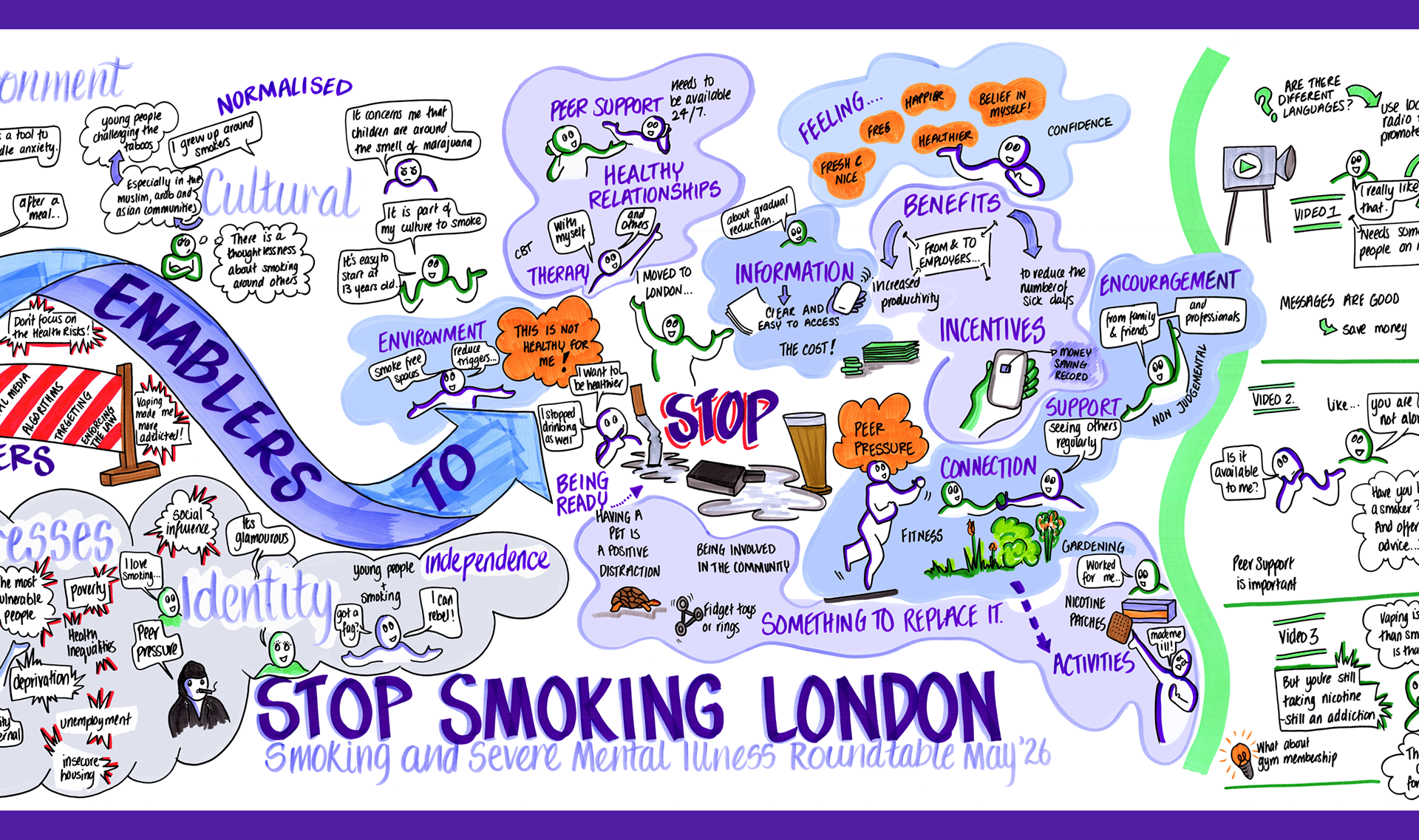
The sessions were developed in partnership with experts by experience, who helped shape the agenda, discussion topics and facilitation approach. One participant also created a series of cartoons inspired by the conversations, while a professional graphic recorder captured the themes emerging from the in-person session.
Together, these visual records provide a powerful and accessible reflection of the discussions and the voices behind them.
Breaking the Link Between Smoking and Mental Health | Roundtable Highlights May 2026
People living with mental health conditions are far more likely to smoke than the general population, yet their voices are often missing from conversations about tobacco control. The insights gathered will help shape future work to reduce smoking-related inequalities and ensure that people with lived experience remain at the heart of decision-making.
What we heard
Four key themes emerged from the conversations.
Smoking as coping, regulation and relief
Participants frequently described smoking as a way of managing stress, anxiety, trauma and mental health symptoms. For many, smoking was seen as a source of comfort, routine and control rather than simply a habit.
Smoking was also linked to neurodivergence, sensory regulation and the need for moments of escape during difficult situations.
Smoking as social connection, belonging and culture
Many participants started smoking during adolescence and described smoking as part of friendship groups, family traditions and cultural norms.
Smoking was often associated with fitting in, shared experiences and a sense of belonging. Participants also highlighted smoking cultures within some mental health settings and communities.
Smoking, deprivation and inequality
The discussions highlighted the strong links between smoking, poverty and wider social inequalities.
Participants spoke about the impact of insecure housing, unemployment, financial pressures and unequal access to support. Smoking was often described as something that becomes harder to address when other challenges feel more immediate.
Quitting is complex, emotional and non-linear
Participants were clear that quitting smoking is rarely straightforward.
Many described feelings of grief, loss and identity change when attempting to stop smoking. Relapse was often discussed as part of the journey rather than a failure.
Several participants felt that public health messaging can sometimes overlook the complex reasons why people smoke, particularly when mental health challenges are involved.
What helps people quit?
The roundtables also explored what participants found most helpful when trying to reduce or stop smoking.
Three key themes emerged:
- Human connection and peer support
- Replacing smoking with meaningful activities and routines
- Flexible, personalised approaches
Participants valued support from people who understood their experiences, whether through peer support, buddy systems or services like the Smoke Free App that recognise the relationship between smoking and mental health.
Activities such as exercise, gardening, caring for pets and using sensory tools were highlighted as useful alternatives to smoking. Participants also supported approaches that recognise different routes to becoming smokefree, including gradual reduction and harm reduction.
What doesn’t help?
Participants consistently rejected judgemental or simplistic approaches.
Health warnings alone were often seen as ineffective, particularly when they failed to acknowledge the realities of living with mental illness. Generic advice that did not take account of disability, trauma or individual circumstances was also viewed as unhelpful.
Instead, participants called for stop smoking support that is realistic, compassionate and tailored to individual needs.
Feedback on Stop Smoking London resources
Participants reviewed a range of Stop Smoking London campaign materials and videos.
They responded positively to content that featured lived experience, diverse voices, honest storytelling and practical information. Participants particularly valued messages that felt relatable and realistic.
Suggestions for improvement included:
- Clearer information about available support
- Greater acknowledgement of setbacks and relapse
- More representation of younger people, disabled people and neurodivergent communities
- Wider availability through community networks and in different languages
A recurring message was that quitting should be shown as a journey rather than a single moment of success.
Thank you everyone who took part
The London Tobacco Alliance would like to thank everyone who contributed their experiences, insights and creativity to these discussions.
The conversations reinforced the importance of involving people with lived experience in the design of tobacco control initiatives. Their perspectives will help shape future campaigns, resources and support for people living with mental health conditions across London.
The visual recordings featured above capture many of the themes, challenges and ideas shared during the sessions and provide a unique insight into the discussions that took place.
A closer look at the artist's visual recording
Why smoke? What is helpful? Feedback on our campaign materials and stories
You may also like
View all News and Events
Significant support among Londoners for ‘smoke free generation’ drive with new law just six months away